How Much Protein Should a Woman in Her 40s Eat? Start With This Simple Number
If you have never counted a gram of protein in your life, you are not behind. You are exactly who this is written for.
So here it is, no math, no app, no food scale.
Aim for about 30 grams of protein at each meal.
Three meals. Thirty grams each. That lands you somewhere around 90 to 100 grams a day, which is a solid, realistic starting point for most women over 40 who want to keep the muscle they have.
That’s the number. Everything below is just how to hit it without turning your kitchen into a science lab.
Why 30 grams, and why it matters more after 40
Your body stops being quite so generous with muscle as you move through perimenopause and menopause. Hormones shift, recovery slows down, and the protein you eat does not get used as efficiently as it did at 25. Researchers call it anabolic resistance – your muscles need a bigger signal to respond the same way.
Thirty grams per meal is roughly the size of signal that gets a response. Not 10 grams scattered across a day. Not one big steak at dinner. A real, repeated dose, three times.
That is why the number works. It is not a magic figure. It is just the simplest version of “enough, often enough.”
And no – this is not about becoming a bodybuilder. It is about walking up stairs without your legs complaining, carrying your own groceries, and holding on to the strength that keeps you independent later.
What 30 grams actually looks like
Here is the part that surprises most women: 30 grams of protein is smaller than you think, and easier than you think. You do not need powders, bars, or a specialty store.
A few real examples:
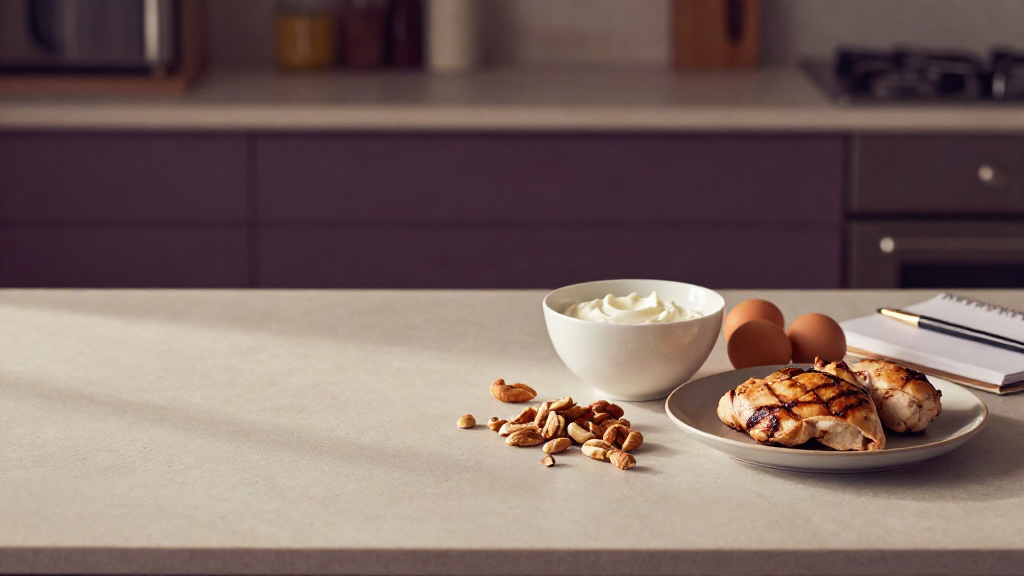
- A single-serve cup of Greek yogurt plus a handful of nuts – about 20 to 25 grams, and easy to push over 30 with a scoop of cottage cheese stirred in.
- Three eggs plus a slice of cheese – around 22 grams, so add a yogurt on the side.
- A palm-sized portion of chicken, salmon, or lean beef – roughly 25 to 30 grams on its own.
- A cup of cottage cheese – about 25 grams, straight out of the tub, zero cooking.
- A can of tuna mixed with Greek yogurt instead of mayo – about 30 grams and it takes two minutes.
Notice the pattern. Protein foods come in threes: eggs and dairy, meat and fish, beans and legumes plus a little something extra. Pick one anchor at each meal and build the plate around it.
Three easy ways to add protein without overhauling every meal
You do not need a new diet. You need three small upgrades.
1. Fix breakfast first
Breakfast is where most women over 40 are running on fumes – a piece of toast, a coffee, maybe a banana. That is 5 grams of protein and a blood sugar crash by 10 a.m.
Swap it for one protein anchor. Greek yogurt with berries. Eggs scrambled with cottage cheese. A leftover chicken thigh from last night, eaten cold, straight from the fridge. Ten minutes, done.
Do this one thing and you have already collected a third of your day.
2. Keep a no-cook option within arm’s reach
The protein you eat is the protein that is easy to eat. So make the easy option the right one.
Keep cottage cheese, hard-boiled eggs, canned tuna, edamame, or a rotisserie chicken in the fridge. When you are tired at 6 p.m., you will reach for what is already there. Set yourself up before you need willpower.
3. Anchor every snack to a protein
You do not have to snack. But if you do, put a protein underneath it. Apple with peanut butter. Crackers with cheese. Yogurt with a few chocolate chips, because this is real life.
A snack with protein holds you to the next meal. A snack without protein just makes you hungrier an hour later.
Do you need to count anything?
No. But if you like a little structure, here is the only counting worth doing at the start:
Count meals, not grams. Three meals, each with one clear protein anchor. If you hit three, you have done the job. If you hit two, you are still better off than yesterday.
Precision matters far less than repetition. You are building a habit, not a spreadsheet.
Two things worth saying plainly
If you are on a GLP-1 medication, this matters even more. Appetite drops, portions shrink, and it becomes easy to eat far less protein than your body needs to hold on to muscle while the scale moves. Getting protein in first, before anything else on the plate, is the practical move. If that is your situation, our free GLP-1 Strength Survival Guide walks through it step by step.
Protein alone is not the whole story. Your muscles need a reason to stay. Three focused strength sessions a week is that reason, and it is why our Strong After 40 program is built around exactly that – three sessions, progressive, joint-friendly, designed for the midlife body.
If you want the full eating framework – how to hit your protein, what to put around it, and how to do it without complicated meal plans – that is what The High-Protein Handbook is for.
And if you would rather start with something free and five days long, the 5-Day Energy Reset is a gentle way in.
Your one action today
Not tomorrow. Today.
At your next meal, put one clear protein anchor on the plate. Yogurt, eggs, chicken, cottage cheese, fish, beans with a little extra. That’s it. Do it again at the next meal.
Three meals. Thirty grams each. That is the whole system, and it starts with the plate in front of you right now.
You are not starting over. You are starting where you are – and that is plenty.
Leave a Reply