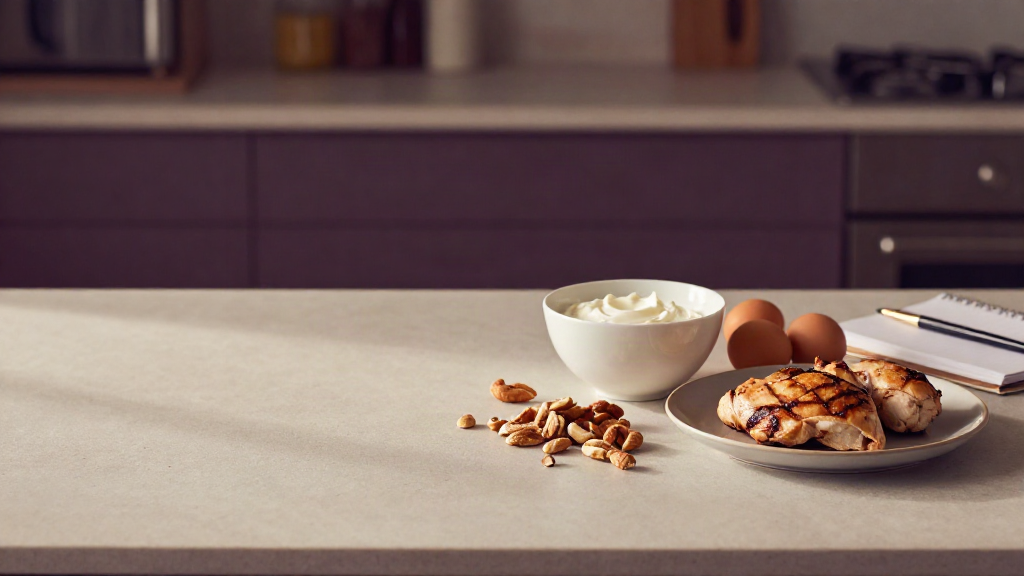
Search “how much protein” and you’ll get five answers in five minutes. One source says 0.8 grams per kilogram of body weight. Another tells you 30 grams at every meal. A third just says “eat more.” None of them explain why the number is different once you’re over 40.
So here’s the straight answer, and then a simple way to find your own number.
The short answer
Most women over 40 do well on 1.2 to 1.6 grams of protein per kilogram of body weight per day. That’s roughly 0.55 to 0.7 grams per pound.
For a woman who weighs 150 pounds (about 68 kilograms), that works out to somewhere between 82 and 109 grams of protein a day. Call it 90 to 100 grams as a practical target.
If you’ve been eating closer to 50 or 60 grams a day, that range probably looks high. It is higher than the standard adult recommendation, and that’s on purpose.
Why the number goes up after 40
The old 0.8 g/kg guideline was built to prevent deficiency, not to keep muscle. Those are two different jobs.
Starting in perimenopause, muscle gets harder to hold onto. Estrogen shifts, and the body becomes less responsive to the protein you eat – a phenomenon researchers call anabolic resistance. You can eat the same plate of food you ate at 35 and use less of it to build and repair muscle at 47.
Add a few rounds of dieting, a busy season of life, and less time for training, and muscle quietly slips away year after year. That’s the part that shows up later as a slower metabolism, lower energy, and feeling weaker than you expect.
Protein is one of the levers you actually control. Strength training is the other. Nutrition first, training right behind it.
How to find your own number in three steps
Step 1: Get your weight in kilograms. Take your weight in pounds and divide by 2.2. A 165-pound woman is about 75 kilograms.
Step 2: Multiply by 1.2 to 1.6. At 75 kilograms, that’s 90 to 120 grams of protein a day. Start at the lower end if you’re new to paying attention to protein, and work up. Jumping straight to the top of the range usually ends in an all-protein week and then a quiet retreat back to toast.
Step 3: Divide across your meals. Aim for 25 to 40 grams per meal, three times a day. This matters more than people think. Your body uses protein better in spaced doses than in one giant dinner. If you eat four smaller meals, 20 to 30 grams each works fine.
That’s the whole method. No app, no calculator required – though if you’d rather not do the math, the High-Protein Handbook walks through the exact targets and how to hit them without a food scale.
What 90 to 100 grams looks like in a normal day
Here’s a day that gets most women into range without anything complicated:
- Breakfast: 1 cup of plain Greek yogurt with a scoop of protein powder and berries – about 35 grams
- Lunch: A big salad with 4 ounces of grilled chicken or canned salmon – about 30 grams
- Snack: Cottage cheese or a hard-boiled egg plus a handful of nuts – about 15 to 20 grams
- Dinner: A palm-and-a-half of lean beef, fish, or tofu with lentils and vegetables – about 30 grams
That’s 110 grams, and every meal looks like a normal meal. No powders required if you don’t want them – they’re just the fastest way to close a gap at breakfast, which is where most women are furthest behind.
If you’re plant-based, you’ll need to be more deliberate. Beans, lentils, tofu, tempeh, edamame, and Greek-style plant yogurts all count, but the portions have to be bigger to land the same number.
Protein on a GLP-1
Women on GLP-1 medications have a specific problem: appetite drops fast, and it’s easy to end up eating very little, including very little protein. That’s how people lose weight and muscle at the same time, which is not the goal.
Two rules help. First, protein comes before everything else on the plate – if you only manage a few bites, make them the protein bites. Second, keep a shake or a yogurt within reach on the days when solid food is unappealing. Twenty to thirty grams in a form you can sip beats a perfect meal you skip.
If that’s your situation, the free GLP-1 Strength Survival Guide goes deeper on protecting muscle while the scale moves.
Three mistakes that keep women under target
Saving protein for dinner. Most women get 15 grams at breakfast and 45 at dinner. Flip that and the whole day gets easier.
Counting protein foods, not protein grams. A handful of almonds has about 6 grams. A tablespoon of peanut butter has 4. These are good foods, but they aren’t the ones that move the number.
Waiting until you’re “ready” to lift. Protein protects muscle best when there’s a reason for the muscle to stay. Two or three strength sessions a week is enough to change the math – see Strong After 40 for a 12-week plan built for three focused sessions a week.
A simple way to check your number
Don’t overhaul your diet. Just do this for three days: write down what you eat and roughly how many grams of protein each meal has. Most women find one clear gap – usually breakfast – and one fix closes it.
If you want the full framework, including a protein target per meal, a list of foods sorted by grams, and no complicated meal plans, the High-Protein Handbook is the complete eating guide for women 40+ who want to lose fat and keep muscle.
Find your number. Hit it most days. Lift a couple of times a week. That’s the whole plan.
Leave a Reply