Protein in Perimenopause and Menopause: How Much You Need to Keep Muscle
If you’re in perimenopause or menopause and you’ve noticed your body doesn’t respond the way it used to, protein is one of the first places to look. Not because it’s trendy. Because the math changes.
Here’s the short answer up front: most women over 40 need more protein than they’re eating, and more than the old “0.8 grams per kilogram” guideline suggests. This guide gives you the number, what it looks like on a plate, and how to actually hit it without living in the kitchen.
Why protein needs shift after 40
Two things happen around this stage of life.
First, muscle gets harder to hold onto. Starting in perimenopause, shifting estrogen levels make it easier to lose muscle and harder to build it back. That matters because muscle is where your strength lives, where a lot of your energy gets used, and why you can still carry the groceries in one trip.
Second, the diet that worked at 30 tends to stop working. Cutting calories hard without enough protein is the fastest way to lose muscle along with fat. You end up smaller and weaker, which is not the goal. The goal is to keep the muscle and let the fat go.
Protein helps with both. It gives your body the raw material to repair and keep muscle, and it keeps you full so you’re not white-knuckling your way to dinner.
How much protein should a woman in her 40s eat?
Forget the minimum for a minute. The 0.8 grams per kilogram guideline was set to prevent deficiency, not to help a midlife woman keep muscle.
Most women over 40 do better in the range of 1.2 to 1.6 grams of protein per kilogram of body weight per day – or roughly 0.5 to 0.7 grams per pound. If you’re actively trying to lose fat, are lifting weights, or are on a GLP-1 medication that kills your appetite, aim toward the higher end.
A quick example. A woman who weighs 160 pounds:
- 160 × 0.5 = 80 grams per day (the floor)
- 160 × 0.7 = 112 grams per day (the goal if she’s training or losing fat)
That’s a wide range on purpose. Hitting 80 is a real win if you’re currently at 45. This isn’t a pass-fail exam.
Watch the per-pound trap
Which number applies to you depends on what you’re weighing. This is where a protein calculator for menopausal women gets tricky, because most calculators use total body weight. If you have a lot of weight to lose, using total body weight can push your target higher than you actually need.
A simple fix: estimate from your goal weight, or use your lean body mass if you know it. Then you’re not chasing a number built on pounds you’re planning to lose.
A protein calculator for women over 40, done by hand
You don’t need an app. Two steps:
- Write down your weight in pounds.
- Multiply by 0.5 for your floor, and by 0.7 for your target.
That’s it. Round to the nearest 5 grams and move on with your day. If you’d rather not do math, the High-Protein Handbook walks through the same framework with protein targets already mapped out for real meals.
What “enough protein” looks like on a plate
Numbers are abstract. Food isn’t. Here’s what 100 grams of protein looks like across a normal day.
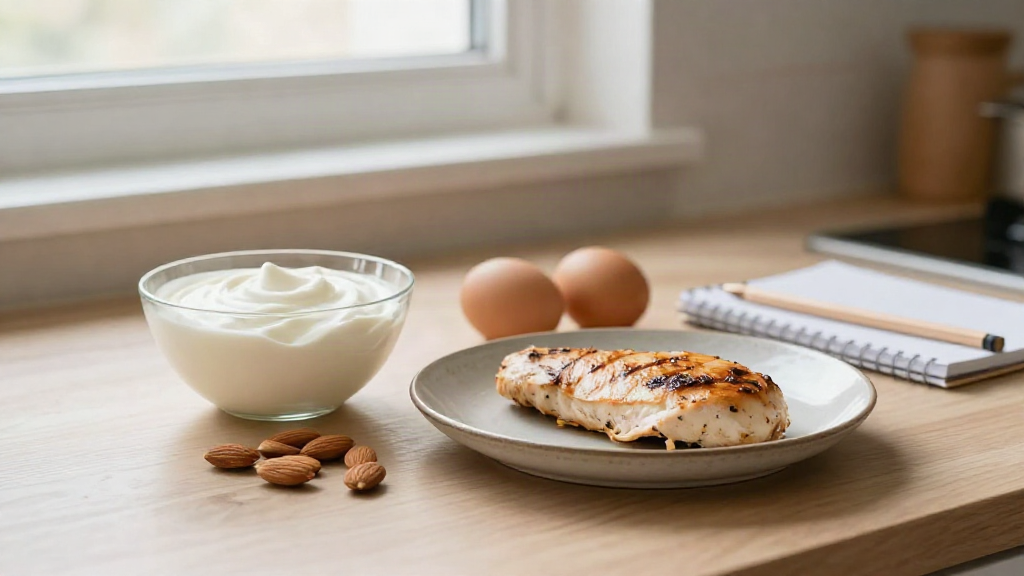
- Breakfast: 1 cup plain Greek yogurt with a scoop of protein powder – about 35 g
- Lunch: 4 oz grilled chicken with a big salad – about 30 g
- Snack: cottage cheese or a handful of almonds plus a hard-boiled egg – about 15 g
- Dinner: 5 oz salmon or lean beef with vegetables – about 35 g
That’s roughly 115 grams without a single “protein meal” or a shaker bottle on the road. The pattern is simple: protein at every meal, not all at dinner.
The one habit that matters most
Front-load your day. Women who eat 30 to 40 grams of protein at breakfast hit their daily target far more often than women who start with toast and try to catch up later. You can’t backload protein in a single dinner and expect it to work.
Simple ways to add protein without overhauling your life
- Anchor every meal to a protein first, then add the rest. Chicken, eggs, fish, Greek yogurt, cottage cheese, tofu, edamame, or lean beef.
- Keep two no-cook options on hand. Rotisserie chicken and cottage cheese have saved more midlife protein targets than any meal plan.
- Stop treating protein as a diet food. It’s a keeping-food. It’s how you stay strong while everything else changes.
- Don’t wait until you’re hungry on a GLP-1. Appetite can drop fast, so protein has to come first and often, in smaller amounts, before you feel like eating.
- Lift something heavy twice a week. Protein builds the material. Strength training tells your body to use it. One without the other leaves results on the table.
If you’re on a GLP-1 medication and worried about losing muscle while the scale drops, grab the free GLP-1 Strength Survival Guide. It’s built exactly for that problem.
If you’re just flat-out tired and don’t know where to start, the free 5-Day Energy Reset is five days of small, doable shifts – protein included – that you’ll actually notice by Friday.
The bottom line
You don’t need a complicated plan. You need a number and a pattern.
Find your weight in pounds, aim for 0.5 to 0.7 grams of protein per pound, and put protein at the front of every meal. That’s the whole system. No crash diets, no punishment cardio, no starting over every Monday.
Your muscle is worth protecting. Start with breakfast tomorrow.
Leave a Reply