Author: brendathrive40

  • How Much Protein Women Over 40 Actually Need (A Straight Answer)

    How Much Protein Women Over 40 Actually Need (A Straight Answer)

    Search “how much protein” and you’ll get five answers in five minutes. One source says 0.8 grams per kilogram of body weight. Another tells you 30 grams at every meal. A third just says “eat more.” None of them explain why the number is different once you’re over 40.

    So here’s the straight answer, and then a simple way to find your own number.

    The short answer

    Most women over 40 do well on 1.2 to 1.6 grams of protein per kilogram of body weight per day. That’s roughly 0.55 to 0.7 grams per pound.

    For a woman who weighs 150 pounds (about 68 kilograms), that works out to somewhere between 82 and 109 grams of protein a day. Call it 90 to 100 grams as a practical target.

    If you’ve been eating closer to 50 or 60 grams a day, that range probably looks high. It is higher than the standard adult recommendation, and that’s on purpose.

    Why the number goes up after 40

    The old 0.8 g/kg guideline was built to prevent deficiency, not to keep muscle. Those are two different jobs.

    Starting in perimenopause, muscle gets harder to hold onto. Estrogen shifts, and the body becomes less responsive to the protein you eat – a phenomenon researchers call anabolic resistance. You can eat the same plate of food you ate at 35 and use less of it to build and repair muscle at 47.

    Add a few rounds of dieting, a busy season of life, and less time for training, and muscle quietly slips away year after year. That’s the part that shows up later as a slower metabolism, lower energy, and feeling weaker than you expect.

    Protein is one of the levers you actually control. Strength training is the other. Nutrition first, training right behind it.

    How to find your own number in three steps

    Step 1: Get your weight in kilograms. Take your weight in pounds and divide by 2.2. A 165-pound woman is about 75 kilograms.

    Step 2: Multiply by 1.2 to 1.6. At 75 kilograms, that’s 90 to 120 grams of protein a day. Start at the lower end if you’re new to paying attention to protein, and work up. Jumping straight to the top of the range usually ends in an all-protein week and then a quiet retreat back to toast.

    Step 3: Divide across your meals. Aim for 25 to 40 grams per meal, three times a day. This matters more than people think. Your body uses protein better in spaced doses than in one giant dinner. If you eat four smaller meals, 20 to 30 grams each works fine.

    That’s the whole method. No app, no calculator required – though if you’d rather not do the math, the High-Protein Handbook walks through the exact targets and how to hit them without a food scale.

    What 90 to 100 grams looks like in a normal day

    Here’s a day that gets most women into range without anything complicated:

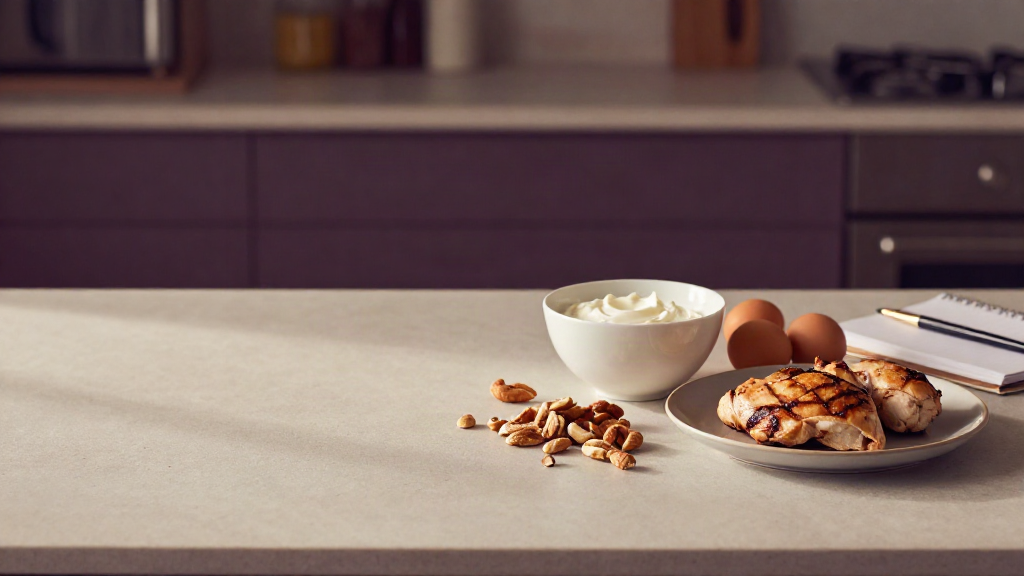
    • Breakfast: 1 cup of plain Greek yogurt with a scoop of protein powder and berries – about 35 grams
    • Lunch: A big salad with 4 ounces of grilled chicken or canned salmon – about 30 grams
    • Snack: Cottage cheese or a hard-boiled egg plus a handful of nuts – about 15 to 20 grams
    • Dinner: A palm-and-a-half of lean beef, fish, or tofu with lentils and vegetables – about 30 grams

    That’s 110 grams, and every meal looks like a normal meal. No powders required if you don’t want them – they’re just the fastest way to close a gap at breakfast, which is where most women are furthest behind.

    If you’re plant-based, you’ll need to be more deliberate. Beans, lentils, tofu, tempeh, edamame, and Greek-style plant yogurts all count, but the portions have to be bigger to land the same number.

    Protein on a GLP-1

    Women on GLP-1 medications have a specific problem: appetite drops fast, and it’s easy to end up eating very little, including very little protein. That’s how people lose weight and muscle at the same time, which is not the goal.

    Two rules help. First, protein comes before everything else on the plate – if you only manage a few bites, make them the protein bites. Second, keep a shake or a yogurt within reach on the days when solid food is unappealing. Twenty to thirty grams in a form you can sip beats a perfect meal you skip.

    If that’s your situation, the free GLP-1 Strength Survival Guide goes deeper on protecting muscle while the scale moves.

    Three mistakes that keep women under target

    Saving protein for dinner. Most women get 15 grams at breakfast and 45 at dinner. Flip that and the whole day gets easier.

    Counting protein foods, not protein grams. A handful of almonds has about 6 grams. A tablespoon of peanut butter has 4. These are good foods, but they aren’t the ones that move the number.

    Waiting until you’re “ready” to lift. Protein protects muscle best when there’s a reason for the muscle to stay. Two or three strength sessions a week is enough to change the math – see Strong After 40 for a 12-week plan built for three focused sessions a week.

    A simple way to check your number

    Don’t overhaul your diet. Just do this for three days: write down what you eat and roughly how many grams of protein each meal has. Most women find one clear gap – usually breakfast – and one fix closes it.

    If you want the full framework, including a protein target per meal, a list of foods sorted by grams, and no complicated meal plans, the High-Protein Handbook is the complete eating guide for women 40+ who want to lose fat and keep muscle.

    Find your number. Hit it most days. Lift a couple of times a week. That’s the whole plan.
  • How Much Protein Should a Woman in Her 40s Eat? Start With This Simple Number

    How Much Protein Should a Woman in Her 40s Eat? Start With This Simple Number

    How Much Protein Should a Woman in Her 40s Eat? Start With This Simple Number

    If you have never counted a gram of protein in your life, you are not behind. You are exactly who this is written for.

    So here it is, no math, no app, no food scale.

    Aim for about 30 grams of protein at each meal.

    Three meals. Thirty grams each. That lands you somewhere around 90 to 100 grams a day, which is a solid, realistic starting point for most women over 40 who want to keep the muscle they have.

    That’s the number. Everything below is just how to hit it without turning your kitchen into a science lab.

    Why 30 grams, and why it matters more after 40

    Your body stops being quite so generous with muscle as you move through perimenopause and menopause. Hormones shift, recovery slows down, and the protein you eat does not get used as efficiently as it did at 25. Researchers call it anabolic resistance – your muscles need a bigger signal to respond the same way.

    Thirty grams per meal is roughly the size of signal that gets a response. Not 10 grams scattered across a day. Not one big steak at dinner. A real, repeated dose, three times.

    That is why the number works. It is not a magic figure. It is just the simplest version of “enough, often enough.”

    And no – this is not about becoming a bodybuilder. It is about walking up stairs without your legs complaining, carrying your own groceries, and holding on to the strength that keeps you independent later.

    What 30 grams actually looks like

    Here is the part that surprises most women: 30 grams of protein is smaller than you think, and easier than you think. You do not need powders, bars, or a specialty store.

    A few real examples:

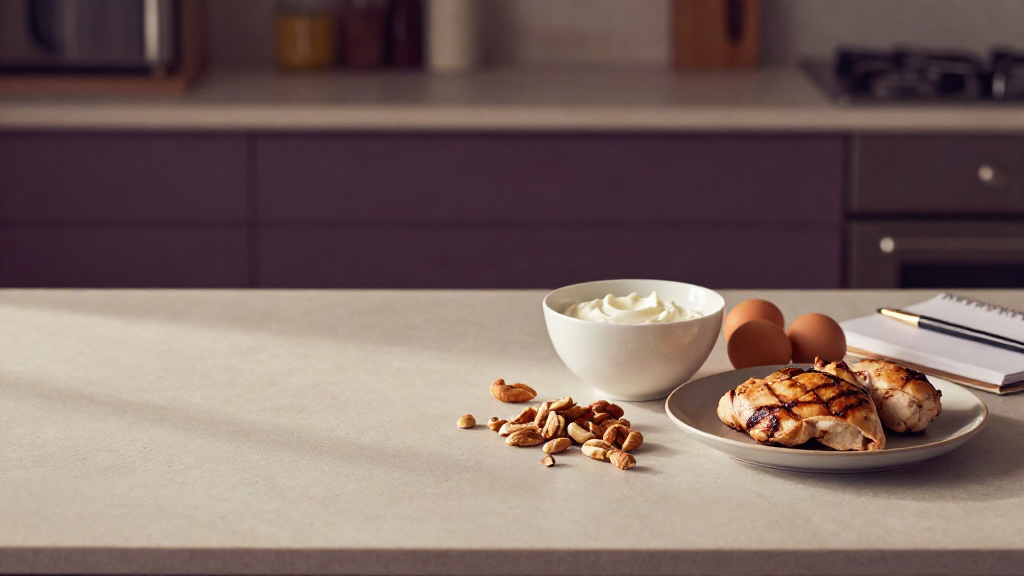
    • A single-serve cup of Greek yogurt plus a handful of nuts – about 20 to 25 grams, and easy to push over 30 with a scoop of cottage cheese stirred in.
    • Three eggs plus a slice of cheese – around 22 grams, so add a yogurt on the side.
    • A palm-sized portion of chicken, salmon, or lean beef – roughly 25 to 30 grams on its own.
    • A cup of cottage cheese – about 25 grams, straight out of the tub, zero cooking.
    • A can of tuna mixed with Greek yogurt instead of mayo – about 30 grams and it takes two minutes.

    Notice the pattern. Protein foods come in threes: eggs and dairy, meat and fish, beans and legumes plus a little something extra. Pick one anchor at each meal and build the plate around it.

    Three easy ways to add protein without overhauling every meal

    You do not need a new diet. You need three small upgrades.

    1. Fix breakfast first

    Breakfast is where most women over 40 are running on fumes – a piece of toast, a coffee, maybe a banana. That is 5 grams of protein and a blood sugar crash by 10 a.m.

    Swap it for one protein anchor. Greek yogurt with berries. Eggs scrambled with cottage cheese. A leftover chicken thigh from last night, eaten cold, straight from the fridge. Ten minutes, done.

    Do this one thing and you have already collected a third of your day.

    2. Keep a no-cook option within arm’s reach

    The protein you eat is the protein that is easy to eat. So make the easy option the right one.

    Keep cottage cheese, hard-boiled eggs, canned tuna, edamame, or a rotisserie chicken in the fridge. When you are tired at 6 p.m., you will reach for what is already there. Set yourself up before you need willpower.

    3. Anchor every snack to a protein

    You do not have to snack. But if you do, put a protein underneath it. Apple with peanut butter. Crackers with cheese. Yogurt with a few chocolate chips, because this is real life.

    A snack with protein holds you to the next meal. A snack without protein just makes you hungrier an hour later.

    Do you need to count anything?

    No. But if you like a little structure, here is the only counting worth doing at the start:

    Count meals, not grams. Three meals, each with one clear protein anchor. If you hit three, you have done the job. If you hit two, you are still better off than yesterday.

    Precision matters far less than repetition. You are building a habit, not a spreadsheet.

    Two things worth saying plainly

    If you are on a GLP-1 medication, this matters even more. Appetite drops, portions shrink, and it becomes easy to eat far less protein than your body needs to hold on to muscle while the scale moves. Getting protein in first, before anything else on the plate, is the practical move. If that is your situation, our free GLP-1 Strength Survival Guide walks through it step by step.

    Protein alone is not the whole story. Your muscles need a reason to stay. Three focused strength sessions a week is that reason, and it is why our Strong After 40 program is built around exactly that – three sessions, progressive, joint-friendly, designed for the midlife body.

    If you want the full eating framework – how to hit your protein, what to put around it, and how to do it without complicated meal plans – that is what The High-Protein Handbook is for.

    And if you would rather start with something free and five days long, the 5-Day Energy Reset is a gentle way in.

    Your one action today

    Not tomorrow. Today.

    At your next meal, put one clear protein anchor on the plate. Yogurt, eggs, chicken, cottage cheese, fish, beans with a little extra. That’s it. Do it again at the next meal.

    Three meals. Thirty grams each. That is the whole system, and it starts with the plate in front of you right now.

    You are not starting over. You are starting where you are – and that is plenty.

  • Protein Calculator for Women Over 40: How to Find Your Target Without a Meal Plan

    Protein Calculator for Women Over 40: How to Find Your Target Without a Meal Plan

    Protein Calculator for Women Over 40: How to Find Your Target Without a Meal Plan

    If you have typed “protein calculator” into a search bar lately, you already know the frustration. Every calculator wants a different number. Some ask for your weight. Some ask for your body fat. Some want to know your activity level on a scale from “couch” to “athlete,” and you are not sure which box a 45-minute strength session three times a week actually belongs in.

    So let’s cut through it. Here are the questions women over 40 actually ask about protein calculators, answered plainly.

    What does a protein calculator actually measure?

    A protein calculator takes a few inputs – usually your body weight, sometimes your activity level – and multiplies them by a grams-per-kilogram-of-body-weight target. That’s it. Behind the clean interface, it’s arithmetic.

    Two things it is not doing:

    It is not measuring your blood, your hormones, or your muscle. It cannot tell you what is happening inside your body.

    It is not personalized to midlife. Most calculators were built around a generic adult, and “generic adult” was never you.

    Think of the result as a starting point, not a verdict. A calculator gives you a number to test. Your job is to test it.

    Why the standard numbers often don’t fit after 40

    The common daily protein recommendation you’ll see in older guidance – around 0.8 grams per kilogram of body weight – was designed to prevent deficiency in a sedentary adult. That’s a floor, not a goal.

    Here’s what changes in midlife:

    Muscle works differently. From around age 40, the body becomes less efficient at building and holding onto muscle. This is a normal part of aging, and it means the amount of protein that was plenty at 30 may not be enough to support the muscle you want to keep.

    Perimenopause and menopause shift the picture. Declining estrogen is linked to changes in where the body stores fat and how it responds to training. Protein and strength work become more important, not less.

    Appetite and schedule change. Women on GLP-1 medications often eat noticeably less, and less often. When total food goes down, protein is one of the first things to slip – which is exactly the nutrient you want to protect.

    Crash diets backfire. Cut calories hard without enough protein and you lose muscle along with fat. That is the opposite of what most women over 40 are after.

    None of this means you need a complicated plan. It means the generic number needs adjusting.

    How much protein should a woman over 40 eat?

    You will see a range in the research. A common starting point for active women in midlife is roughly 1.2 to 1.6 grams of protein per kilogram of body weight per day – higher than the old floor, and notably higher for women who are strength training or actively trying to lose fat while keeping muscle.

    If math in grams-per-kilogram makes your eyes glaze over, here is the shortcut I use with clients: aim for a palm-sized portion of protein at each meal, and build from there.

    That is roughly:

    • Breakfast: 25 to 30 grams
    • Lunch: 30 to 35 grams
    • Dinner: 30 to 35 grams
    • One small protein-forward snack if you need it

    Add those up and most women land in the right neighborhood without tracking a single thing.

    How to sanity-check your target in one week

    You do not need an app, a food scale, or a meal plan. You need one week and a pen.

    1. Pick a number. Run the math above, or choose a reasonable starting target between 90 and 130 grams a day.
    2. Hit it for seven days. Not perfectly. Aim for six out of seven.
    3. Track only one thing. Protein. Ignore carbs, fat, and calories for this week.
    4. Rate your days. Each evening, jot a 1 to 5 on energy, how hungry you felt between meals, and how your strength sessions went.
    5. Read the signals. If you were starving all week, your number is probably too low or your meals are too light on protein early in the day. If you felt strong and steady, you found your range.

    Repeat with a small bump – say 10 grams – if you want to test the next level. That’s the whole system.

    Do I need a meal plan to hit my protein target?

    No. Meal plans fail for a simple reason: they ask you to live inside someone else’s food choices. The moment your week goes sideways, the plan goes in the drawer.

    What works instead is a small set of repeatable moves:

    • Anchor every meal with a protein first, then add the rest.
    • Keep two or three no-think protein options on hand – Greek yogurt, eggs, rotisserie chicken, cottage cheese, canned tuna.
    • Front-load breakfast. It’s the meal most women underdo, and fixing it makes the rest of the day easy.
    • Plan protein, not menus.

    What about protein while losing fat?

    If fat loss is the goal, protein does two jobs at once: it helps protect muscle while the scale moves, and it keeps you full so you are not white-knuckling your way to dinner.

    The mistake is dropping calories and protein together. Keep the protein high, cut elsewhere.

    And if you are losing weight with the help of a GLP-1 medication, this matters even more. Smaller portions and lower appetite make it easy to fall short on protein without noticing. Women on GLP-1s have a specific reason to treat protein as the non-negotiable part of the day.

    The bottom line

    A protein calculator is a starting point, not an answer key. Use it to get in the ballpark, then spend one week testing whether that number leaves you strong, steady, and not starving. Adjust by 10 grams. Repeat.

    No crash diets. No complicated meal plans. Just a number you can actually hit.

    If you want the whole framework laid out for you – how much protein, which foods, and how to build it into real meals without tracking – The High-Protein Handbook is the complete eating guide for women 40+ who want to lose fat and keep muscle.

    Get The High-Protein Handbook →

  • Protein in Perimenopause and Menopause: How Much You Need to Keep Muscle

    Protein in Perimenopause and Menopause: How Much You Need to Keep Muscle

    Protein in Perimenopause and Menopause: How Much You Need to Keep Muscle

    If you’re in perimenopause or menopause and you’ve noticed your body doesn’t respond the way it used to, protein is one of the first places to look. Not because it’s trendy. Because the math changes.

    Here’s the short answer up front: most women over 40 need more protein than they’re eating, and more than the old “0.8 grams per kilogram” guideline suggests. This guide gives you the number, what it looks like on a plate, and how to actually hit it without living in the kitchen.

    Why protein needs shift after 40

    Two things happen around this stage of life.

    First, muscle gets harder to hold onto. Starting in perimenopause, shifting estrogen levels make it easier to lose muscle and harder to build it back. That matters because muscle is where your strength lives, where a lot of your energy gets used, and why you can still carry the groceries in one trip.

    Second, the diet that worked at 30 tends to stop working. Cutting calories hard without enough protein is the fastest way to lose muscle along with fat. You end up smaller and weaker, which is not the goal. The goal is to keep the muscle and let the fat go.

    Protein helps with both. It gives your body the raw material to repair and keep muscle, and it keeps you full so you’re not white-knuckling your way to dinner.

    How much protein should a woman in her 40s eat?

    Forget the minimum for a minute. The 0.8 grams per kilogram guideline was set to prevent deficiency, not to help a midlife woman keep muscle.

    Most women over 40 do better in the range of 1.2 to 1.6 grams of protein per kilogram of body weight per day – or roughly 0.5 to 0.7 grams per pound. If you’re actively trying to lose fat, are lifting weights, or are on a GLP-1 medication that kills your appetite, aim toward the higher end.

    A quick example. A woman who weighs 160 pounds:

    • 160 × 0.5 = 80 grams per day (the floor)
    • 160 × 0.7 = 112 grams per day (the goal if she’s training or losing fat)

    That’s a wide range on purpose. Hitting 80 is a real win if you’re currently at 45. This isn’t a pass-fail exam.

    Watch the per-pound trap

    Which number applies to you depends on what you’re weighing. This is where a protein calculator for menopausal women gets tricky, because most calculators use total body weight. If you have a lot of weight to lose, using total body weight can push your target higher than you actually need.

    A simple fix: estimate from your goal weight, or use your lean body mass if you know it. Then you’re not chasing a number built on pounds you’re planning to lose.

    A protein calculator for women over 40, done by hand

    You don’t need an app. Two steps:

    1. Write down your weight in pounds.
    2. Multiply by 0.5 for your floor, and by 0.7 for your target.

    That’s it. Round to the nearest 5 grams and move on with your day. If you’d rather not do math, the High-Protein Handbook walks through the same framework with protein targets already mapped out for real meals.

    What “enough protein” looks like on a plate

    Numbers are abstract. Food isn’t. Here’s what 100 grams of protein looks like across a normal day.

    • Breakfast: 1 cup plain Greek yogurt with a scoop of protein powder – about 35 g
    • Lunch: 4 oz grilled chicken with a big salad – about 30 g
    • Snack: cottage cheese or a handful of almonds plus a hard-boiled egg – about 15 g
    • Dinner: 5 oz salmon or lean beef with vegetables – about 35 g

    That’s roughly 115 grams without a single “protein meal” or a shaker bottle on the road. The pattern is simple: protein at every meal, not all at dinner.

    The one habit that matters most

    Front-load your day. Women who eat 30 to 40 grams of protein at breakfast hit their daily target far more often than women who start with toast and try to catch up later. You can’t backload protein in a single dinner and expect it to work.

    Simple ways to add protein without overhauling your life

    • Anchor every meal to a protein first, then add the rest. Chicken, eggs, fish, Greek yogurt, cottage cheese, tofu, edamame, or lean beef.
    • Keep two no-cook options on hand. Rotisserie chicken and cottage cheese have saved more midlife protein targets than any meal plan.
    • Stop treating protein as a diet food. It’s a keeping-food. It’s how you stay strong while everything else changes.
    • Don’t wait until you’re hungry on a GLP-1. Appetite can drop fast, so protein has to come first and often, in smaller amounts, before you feel like eating.
    • Lift something heavy twice a week. Protein builds the material. Strength training tells your body to use it. One without the other leaves results on the table.

    If you’re on a GLP-1 medication and worried about losing muscle while the scale drops, grab the free GLP-1 Strength Survival Guide. It’s built exactly for that problem.

    If you’re just flat-out tired and don’t know where to start, the free 5-Day Energy Reset is five days of small, doable shifts – protein included – that you’ll actually notice by Friday.

    The bottom line

    You don’t need a complicated plan. You need a number and a pattern.

    Find your weight in pounds, aim for 0.5 to 0.7 grams of protein per pound, and put protein at the front of every meal. That’s the whole system. No crash diets, no punishment cardio, no starting over every Monday.

    Your muscle is worth protecting. Start with breakfast tomorrow.

  • How Much Protein Should a Woman Over 40 Eat? A Simple Way to Find Your Number

    How Much Protein Should a Woman Over 40 Eat? A Simple Way to Find Your Number

    How Much Protein Should a Woman Over 40 Eat? A Simple Way to Find Your Number

    If you have typed “how much protein should a woman in her 40s eat” into a search bar, you have probably gotten twenty different answers. One site says 50 grams. Another says 150. Most of them never show you the math.

    So here it is, plain. One number you can actually find for yourself, using your body weight and how active you are. No meal plan. No memorizing food tables. Just the calculation, a worked example, and the simple way to put it into practice.

    The short answer

    Most women over 40 land somewhere between 0.7 and 1 gram of protein per pound of body weight per day.

    That is a range, not a rule. Where you fall inside it depends on two things: how much you are training, and whether you are trying to lose fat while keeping muscle. Both push your number up.

    For reference, that range is higher than the standard advice given to the general population. That is on purpose. After 40, your body uses protein less efficiently, so you need more of it to get the same result.

    Step 1: Start with your weight

    Take your current body weight in pounds. Round it to the nearest ten. If you are 168, use 170. Keep it simple, because the goal here is a target you will actually use, not a number that is perfect on paper.

    If you are planning a significant fat-loss phase, you can also run the math on a realistic goal weight. That gives you a second number to compare against. Most women find the two are close enough that the plan does not change much.

    Step 2: Pick your multiplier

    This is the only judgment call in the whole process.

    • 0.7 grams per pound if you are moderately active but not doing much strength training. This is your floor.
    • 0.8 grams per pound if you lift weights or do resistance training two to three times a week.
    • 0.9 to 1 gram per pound if you are strength training and eating in a calorie deficit to lose weight, or if you are on a GLP-1 medication and want to protect muscle while the scale drops.

    Notice that none of those numbers require you to count anything else. No carb math. No macro spreadsheets. Protein first, and the rest tends to sort itself out.

    Step 3: Do the math

    Let’s run a real one.

    A 170-pound woman, 44, lifting three days a week, wanting to lose some fat:

    170 x 0.8 = 136 grams
    170 x 1.0 = 170 grams

    She aims for roughly 140 grams a day. Not 136 on the nose. Somewhere in that neighborhood, most days.

    Second example. A 150-pound woman, 52, in perimenopause, walking daily and new to strength training:

    150 x 0.7 = 105 grams
    150 x 0.8 = 120 grams

    She aims for about 115 grams a day.

    That is it. That is the whole calculation.

    How to spread it across the day

    The daily total matters, but how you split it matters too. Your body builds muscle best in response to protein spread out across the day, not dumped into one meal.

    The practical version: aim for 30 to 40 grams at each of three meals, plus a 20 to 30 gram snack. That lands a 140-gram target without much fuss.

    Most women I talk to are fine at dinner. Breakfast is where it falls apart. A coffee and a piece of toast is roughly 8 grams. Swap in eggs and Greek yogurt, or add cottage cheese to what you already eat, and you are most of the way to 35 before 9 a.m.

    Why the number is higher after 40

    Three things happen at once, and they all point the same direction.

    Muscle becomes harder to keep. Adults lose muscle with age, and that process speeds up around menopause. Muscle is what keeps you strong, keeps your metabolism from sliding, and keeps you independent decades from now.

    Hormones shift. Falling estrogen changes how your body responds to food and where it stores fat. The same diet that worked at 35 often stops working at 45.

    A calorie deficit raises the stakes. When you eat less to lose fat, your body looks for something to burn. Without enough protein and resistance training, some of what it burns is muscle. You lose weight and get weaker at the same time. That is the outcome protein is there to prevent.

    If you are on a GLP-1

    Appetite drops. Meals get small. Protein often gets pushed off the plate first, because it takes longer to eat and it fills you up.

    That is exactly backwards. When you are on a GLP-1 and losing weight, protein is the thing worth protecting. Front-load it. Eat the chicken before the rice. Keep a shake or a high-protein yogurt on hand for the days when real food feels like too much. And add strength training, because protein without a reason to use it only goes so far.

    Our GLP-1 Strength Survival Guide walks through this in more detail, and it is free.

    Hitting your number without a meal plan

    You do not need a printable week of meals. You need a handful of go-to proteins you actually like.

    Pick five. Rotate them. Eggs, Greek yogurt, cottage cheese, chicken, ground turkey, salmon, canned tuna, tofu, lentils, a quality protein powder. Then build every meal around the protein instead of around the side dish.

    If appetite is low, lean on the easy options: a shake, a yogurt cup, a handful of turkey slices. It counts. Perfection is not the point. Getting close most days is.

    Common questions

    Is 100 grams of protein a day enough?
    Depends on your weight. For a 140-pound woman, 100 grams sits comfortably in range. For a 190-pound woman, it is below where she should be. Run your own numbers first.

    Does protein from vegetables and grains count?
    It counts, but plant sources are not dense enough to anchor a meal on their own. Keep them, and pair them with a clear protein.

    Do I need a shake?
    No. Shakes are a tool for the days when food is inconvenient, not a requirement.

    Is that much protein hard on my kidneys?
    For healthy kidneys, higher protein intakes are well tolerated. If you have a diagnosed kidney condition, talk to your doctor before changing your intake. This article is general guidance, not medical advice.

    What if I am not hungry in the morning?
    Start small. A yogurt cup is 15 grams and takes two minutes.

    Your next step

    Find your number today. Weight times multiplier. Write it on a sticky note and put it on the fridge.

    Then work on the how: meals, portions, and a plan you can repeat on a Tuesday when you are tired. The High-Protein Handbook is the complete eating framework for women 40+ who want to lose fat and keep muscle, with no complicated meal plans. And if your number is only useful when your body is strong enough to use it, Strong After 40 is the 12-week strength program built for the midlife body.

    Not punishment cardio. Not crash diets. Just your number, and the habits that make it work.

  • Protein in Menopause and Perimenopause: Your Questions, Answered

    Protein in Menopause and Perimenopause: Your Questions, Answered

    Protein gets a lot of airtime after 40, and most of it is noise. Powders, timelines, “eat this not that” charts. What women actually want is a straight answer to a simple question: how much protein do I need now that my body has changed?

    Here are the questions we hear most from women in perimenopause and menopause, answered the way we would answer them over coffee. No clinical jargon, no crash-diet math, and no pretending this is more complicated than it is.

    How much protein should a woman in her 40s eat?

    For most women over 40, the honest starting point is higher than the old “0.8 grams per pound of body weight” style advice you may remember from a food label decades ago.

    A practical range to aim for is roughly 1.2 to 1.6 grams of protein per kilogram of body weight per day – and on the higher end of that if you are training, actively losing fat, or eating less overall. In pounds, that is a good deal more protein than most women are getting right now.

    The reason it is a range and not a single number: your body weight, your activity, how much you are eating in total, and whether you are lifting weights all shift the target. That is exactly why we built a simple protein calculator for women over 40 – you put in a few basics and get one number to aim for instead of a spreadsheet.

    If you want the short version: most women over 40 do better when they stop treating protein as a side dish and start treating it as the anchor of the plate.

    Why do the old guidelines not fit a midlife body?

    Those guidelines were written for a general adult population, not for a woman whose hormones are shifting, whose appetite may be changing week to week, and who is quietly losing muscle.

    Three things change after 40:

    • Muscle gets harder to keep. From around perimenopause onward, the body is less responsive to the protein you eat. You need more of it to get the same muscle-preserving effect.
    • Appetite gets less predictable. Some weeks you are hungry; some weeks nothing sounds good. When intake drops, protein is usually the first thing to go.
    • Fat loss gets less forgiving. If you cut calories without protecting protein, you tend to lose muscle along with fat – which is the opposite of what you want.

    So the old number is not wrong. It is just too low and too generic for this stage of life. This is the same reasoning behind the protein calculator for menopausal women we point women to first.

    Am I really losing muscle, or does it just feel like it?

    It rarely feels like anything at first. That is the problem.

    Muscle loss after 40 is quiet. It shows up as feeling weaker on stairs, needing two hands for a grocery bag, or noticing that the same weights feel heavier than they used to. It shows up as a body that looks softer even when the scale has not moved.

    Protein alone does not fix that. Protein plus resistance training is the combination that does. Protein gives your body the material; lifting tells your body to use it. One without the other leaves results on the table, which is why our Strong After 40 program is built around three focused strength sessions a week rather than daily punishment cardio.

    If I am on a GLP-1, does protein still matter?

    Yes – and it matters more, not less.

    Women on GLP-1 medications often eat noticeably less without trying to. That is the point of the medication. But when total intake drops, protein drops with it, and the risk of losing muscle while the scale goes down goes up.

    The fix is not complicated, but it does need a plan:

    • Front-load protein early in the day, before appetite fades.
    • Anchor every meal to a protein first, then add the rest.
    • Keep lifting. Muscle you do not use, you lose.
    • Track loosely. You are not counting every gram forever – just long enough to see where you actually land.

    We put the essentials into a free GLP-1 Strength Survival Guide for exactly this situation. No scare tactics, no judgment, just how to keep your muscle while the weight comes off.

    What does a high-protein day actually look like?

    This is where most advice gets useless. Telling someone to eat 120 grams of protein is not a plan. Here is the plain version.

    Build the day around three protein anchors and one snack:

    1. Breakfast – eggs, Greek yogurt, or cottage cheese. Aim for 30 grams.
    2. Lunch – leftover chicken, tuna, or a big salad with salmon or shrimp. Aim for 30 to 40 grams.
    3. Dinner – a palm-and-a-half of meat, fish, or tofu plus a side. Aim for 30 to 40 grams.
    4. Snack – a shake, a cheese stick, or jerky if you are short. Aim for 15 to 25 grams.

    That lands most women in the range they need without weighing food or building a meal plan from scratch. If you want the full framework – including how to handle restaurant meals, travel, and the weeks when cooking is not happening – that is what The High-Protein Handbook is for.

    Quick answers to the rest

    Do I need protein powder? No. It is convenient, not required. Real food first, powder as a gap-filler.

    Is more protein bad for my kidneys? For healthy kidneys, higher protein within reason is not a concern. If you have kidney disease, talk to your doctor about your specific target – that is a real exception, not a scare tactic.

    Should I spread protein across the day or eat it all at dinner? Spreading it out tends to work better for muscle and for appetite.

    Does protein make you gain weight? No. Excess calories do. Protein is the thing that keeps you full enough to eat less without feeling deprived.

    What if I do not eat meat? Greek yogurt, cottage cheese, eggs, tofu, tempeh, edamame, lentils, and a quality plant protein powder all count. It takes a little more planning, not a different rulebook.

    How long until I notice a difference? Energy and fullness usually show up within a week or two. Strength and body composition take longer – think weeks, not days.

    Start with one number, not a whole new life

    You do not need a perfect diet. You need one target that is right for your body, and a simple way to hit it most days.

    Figure out your daily protein number, pick three protein anchors you actually like, and keep lifting. That is the whole system. Everything else is detail.

    If you want the number and the framework in one place, start with the High-Protein Handbook – it is written for women over 40 who are done with crash diets and want straight answers instead.