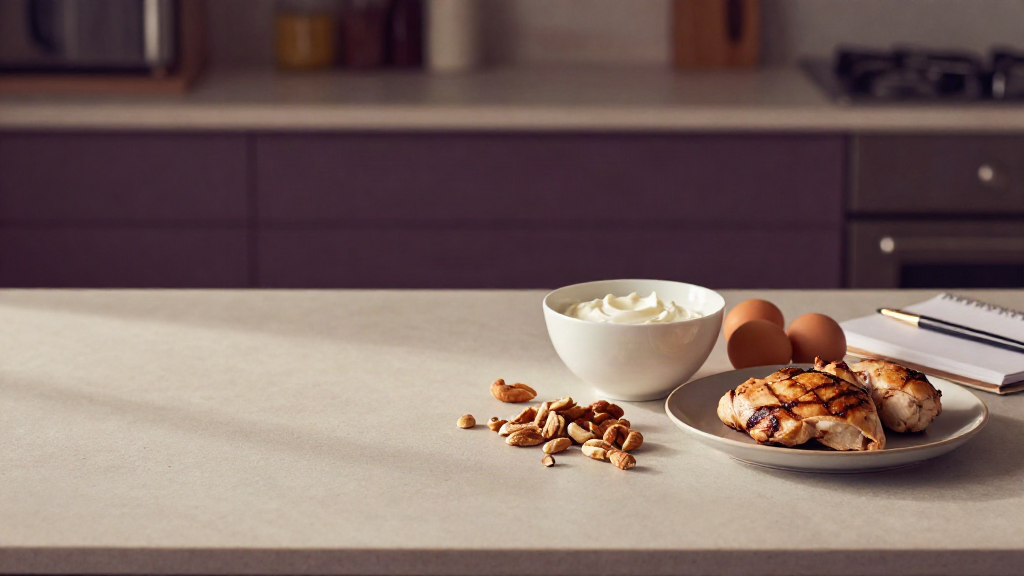
How Much Protein Should a Woman Over 40 Eat? A Simple Way to Find Your Number
If you have typed “how much protein should a woman in her 40s eat” into a search bar, you have probably gotten twenty different answers. One site says 50 grams. Another says 150. Most of them never show you the math.
So here it is, plain. One number you can actually find for yourself, using your body weight and how active you are. No meal plan. No memorizing food tables. Just the calculation, a worked example, and the simple way to put it into practice.
The short answer
Most women over 40 land somewhere between 0.7 and 1 gram of protein per pound of body weight per day.
That is a range, not a rule. Where you fall inside it depends on two things: how much you are training, and whether you are trying to lose fat while keeping muscle. Both push your number up.
For reference, that range is higher than the standard advice given to the general population. That is on purpose. After 40, your body uses protein less efficiently, so you need more of it to get the same result.
Step 1: Start with your weight
Take your current body weight in pounds. Round it to the nearest ten. If you are 168, use 170. Keep it simple, because the goal here is a target you will actually use, not a number that is perfect on paper.
If you are planning a significant fat-loss phase, you can also run the math on a realistic goal weight. That gives you a second number to compare against. Most women find the two are close enough that the plan does not change much.
Step 2: Pick your multiplier
This is the only judgment call in the whole process.
- 0.7 grams per pound if you are moderately active but not doing much strength training. This is your floor.
- 0.8 grams per pound if you lift weights or do resistance training two to three times a week.
- 0.9 to 1 gram per pound if you are strength training and eating in a calorie deficit to lose weight, or if you are on a GLP-1 medication and want to protect muscle while the scale drops.
Notice that none of those numbers require you to count anything else. No carb math. No macro spreadsheets. Protein first, and the rest tends to sort itself out.
Step 3: Do the math
Let’s run a real one.
A 170-pound woman, 44, lifting three days a week, wanting to lose some fat:
170 x 0.8 = 136 grams
170 x 1.0 = 170 grams
She aims for roughly 140 grams a day. Not 136 on the nose. Somewhere in that neighborhood, most days.
Second example. A 150-pound woman, 52, in perimenopause, walking daily and new to strength training:
150 x 0.7 = 105 grams
150 x 0.8 = 120 grams
She aims for about 115 grams a day.
That is it. That is the whole calculation.
How to spread it across the day
The daily total matters, but how you split it matters too. Your body builds muscle best in response to protein spread out across the day, not dumped into one meal.
The practical version: aim for 30 to 40 grams at each of three meals, plus a 20 to 30 gram snack. That lands a 140-gram target without much fuss.
Most women I talk to are fine at dinner. Breakfast is where it falls apart. A coffee and a piece of toast is roughly 8 grams. Swap in eggs and Greek yogurt, or add cottage cheese to what you already eat, and you are most of the way to 35 before 9 a.m.
Why the number is higher after 40
Three things happen at once, and they all point the same direction.
Muscle becomes harder to keep. Adults lose muscle with age, and that process speeds up around menopause. Muscle is what keeps you strong, keeps your metabolism from sliding, and keeps you independent decades from now.
Hormones shift. Falling estrogen changes how your body responds to food and where it stores fat. The same diet that worked at 35 often stops working at 45.
A calorie deficit raises the stakes. When you eat less to lose fat, your body looks for something to burn. Without enough protein and resistance training, some of what it burns is muscle. You lose weight and get weaker at the same time. That is the outcome protein is there to prevent.
If you are on a GLP-1
Appetite drops. Meals get small. Protein often gets pushed off the plate first, because it takes longer to eat and it fills you up.
That is exactly backwards. When you are on a GLP-1 and losing weight, protein is the thing worth protecting. Front-load it. Eat the chicken before the rice. Keep a shake or a high-protein yogurt on hand for the days when real food feels like too much. And add strength training, because protein without a reason to use it only goes so far.
Our GLP-1 Strength Survival Guide walks through this in more detail, and it is free.
Hitting your number without a meal plan
You do not need a printable week of meals. You need a handful of go-to proteins you actually like.
Pick five. Rotate them. Eggs, Greek yogurt, cottage cheese, chicken, ground turkey, salmon, canned tuna, tofu, lentils, a quality protein powder. Then build every meal around the protein instead of around the side dish.
If appetite is low, lean on the easy options: a shake, a yogurt cup, a handful of turkey slices. It counts. Perfection is not the point. Getting close most days is.
Common questions
Is 100 grams of protein a day enough?
Depends on your weight. For a 140-pound woman, 100 grams sits comfortably in range. For a 190-pound woman, it is below where she should be. Run your own numbers first.
Does protein from vegetables and grains count?
It counts, but plant sources are not dense enough to anchor a meal on their own. Keep them, and pair them with a clear protein.
Do I need a shake?
No. Shakes are a tool for the days when food is inconvenient, not a requirement.
Is that much protein hard on my kidneys?
For healthy kidneys, higher protein intakes are well tolerated. If you have a diagnosed kidney condition, talk to your doctor before changing your intake. This article is general guidance, not medical advice.
What if I am not hungry in the morning?
Start small. A yogurt cup is 15 grams and takes two minutes.
Your next step
Find your number today. Weight times multiplier. Write it on a sticky note and put it on the fridge.
Then work on the how: meals, portions, and a plan you can repeat on a Tuesday when you are tired. The High-Protein Handbook is the complete eating framework for women 40+ who want to lose fat and keep muscle, with no complicated meal plans. And if your number is only useful when your body is strong enough to use it, Strong After 40 is the 12-week strength program built for the midlife body.
Not punishment cardio. Not crash diets. Just your number, and the habits that make it work.
Leave a Reply