Protein gets a lot of airtime after 40, and most of it is noise. Powders, timelines, “eat this not that” charts. What women actually want is a straight answer to a simple question: how much protein do I need now that my body has changed?
Here are the questions we hear most from women in perimenopause and menopause, answered the way we would answer them over coffee. No clinical jargon, no crash-diet math, and no pretending this is more complicated than it is.
How much protein should a woman in her 40s eat?
For most women over 40, the honest starting point is higher than the old “0.8 grams per pound of body weight” style advice you may remember from a food label decades ago.
A practical range to aim for is roughly 1.2 to 1.6 grams of protein per kilogram of body weight per day – and on the higher end of that if you are training, actively losing fat, or eating less overall. In pounds, that is a good deal more protein than most women are getting right now.
The reason it is a range and not a single number: your body weight, your activity, how much you are eating in total, and whether you are lifting weights all shift the target. That is exactly why we built a simple protein calculator for women over 40 – you put in a few basics and get one number to aim for instead of a spreadsheet.
If you want the short version: most women over 40 do better when they stop treating protein as a side dish and start treating it as the anchor of the plate.
Why do the old guidelines not fit a midlife body?
Those guidelines were written for a general adult population, not for a woman whose hormones are shifting, whose appetite may be changing week to week, and who is quietly losing muscle.
Three things change after 40:
- Muscle gets harder to keep. From around perimenopause onward, the body is less responsive to the protein you eat. You need more of it to get the same muscle-preserving effect.
- Appetite gets less predictable. Some weeks you are hungry; some weeks nothing sounds good. When intake drops, protein is usually the first thing to go.
- Fat loss gets less forgiving. If you cut calories without protecting protein, you tend to lose muscle along with fat – which is the opposite of what you want.
So the old number is not wrong. It is just too low and too generic for this stage of life. This is the same reasoning behind the protein calculator for menopausal women we point women to first.
Am I really losing muscle, or does it just feel like it?
It rarely feels like anything at first. That is the problem.
Muscle loss after 40 is quiet. It shows up as feeling weaker on stairs, needing two hands for a grocery bag, or noticing that the same weights feel heavier than they used to. It shows up as a body that looks softer even when the scale has not moved.
Protein alone does not fix that. Protein plus resistance training is the combination that does. Protein gives your body the material; lifting tells your body to use it. One without the other leaves results on the table, which is why our Strong After 40 program is built around three focused strength sessions a week rather than daily punishment cardio.
If I am on a GLP-1, does protein still matter?
Yes – and it matters more, not less.
Women on GLP-1 medications often eat noticeably less without trying to. That is the point of the medication. But when total intake drops, protein drops with it, and the risk of losing muscle while the scale goes down goes up.
The fix is not complicated, but it does need a plan:
- Front-load protein early in the day, before appetite fades.
- Anchor every meal to a protein first, then add the rest.
- Keep lifting. Muscle you do not use, you lose.
- Track loosely. You are not counting every gram forever – just long enough to see where you actually land.
We put the essentials into a free GLP-1 Strength Survival Guide for exactly this situation. No scare tactics, no judgment, just how to keep your muscle while the weight comes off.
What does a high-protein day actually look like?
This is where most advice gets useless. Telling someone to eat 120 grams of protein is not a plan. Here is the plain version.
Build the day around three protein anchors and one snack:
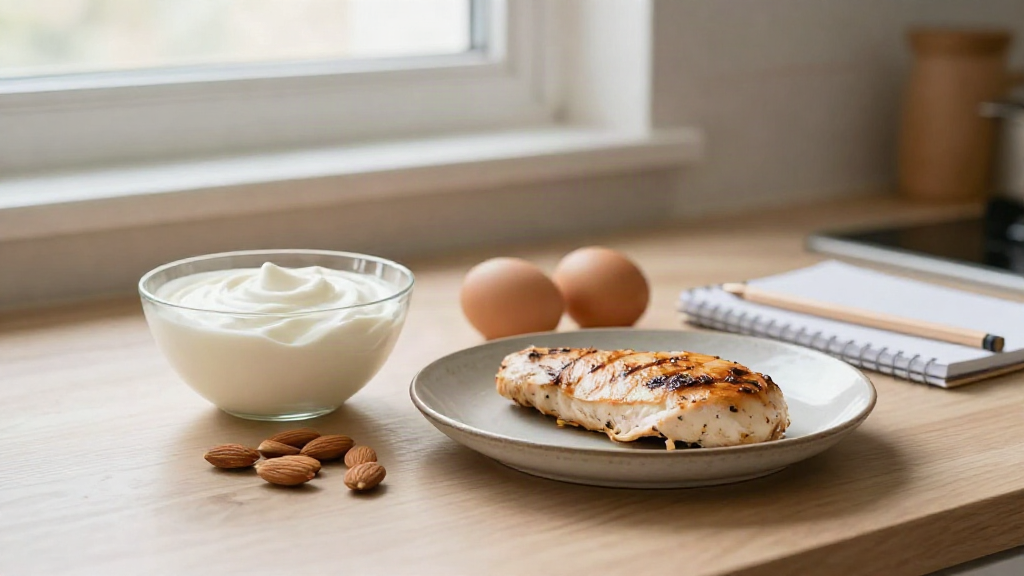
- Breakfast – eggs, Greek yogurt, or cottage cheese. Aim for 30 grams.
- Lunch – leftover chicken, tuna, or a big salad with salmon or shrimp. Aim for 30 to 40 grams.
- Dinner – a palm-and-a-half of meat, fish, or tofu plus a side. Aim for 30 to 40 grams.
- Snack – a shake, a cheese stick, or jerky if you are short. Aim for 15 to 25 grams.
That lands most women in the range they need without weighing food or building a meal plan from scratch. If you want the full framework – including how to handle restaurant meals, travel, and the weeks when cooking is not happening – that is what The High-Protein Handbook is for.
Quick answers to the rest
Do I need protein powder? No. It is convenient, not required. Real food first, powder as a gap-filler.
Is more protein bad for my kidneys? For healthy kidneys, higher protein within reason is not a concern. If you have kidney disease, talk to your doctor about your specific target – that is a real exception, not a scare tactic.
Should I spread protein across the day or eat it all at dinner? Spreading it out tends to work better for muscle and for appetite.
Does protein make you gain weight? No. Excess calories do. Protein is the thing that keeps you full enough to eat less without feeling deprived.
What if I do not eat meat? Greek yogurt, cottage cheese, eggs, tofu, tempeh, edamame, lentils, and a quality plant protein powder all count. It takes a little more planning, not a different rulebook.
How long until I notice a difference? Energy and fullness usually show up within a week or two. Strength and body composition take longer – think weeks, not days.
Start with one number, not a whole new life
You do not need a perfect diet. You need one target that is right for your body, and a simple way to hit it most days.
Figure out your daily protein number, pick three protein anchors you actually like, and keep lifting. That is the whole system. Everything else is detail.
If you want the number and the framework in one place, start with the High-Protein Handbook – it is written for women over 40 who are done with crash diets and want straight answers instead.
Leave a Reply